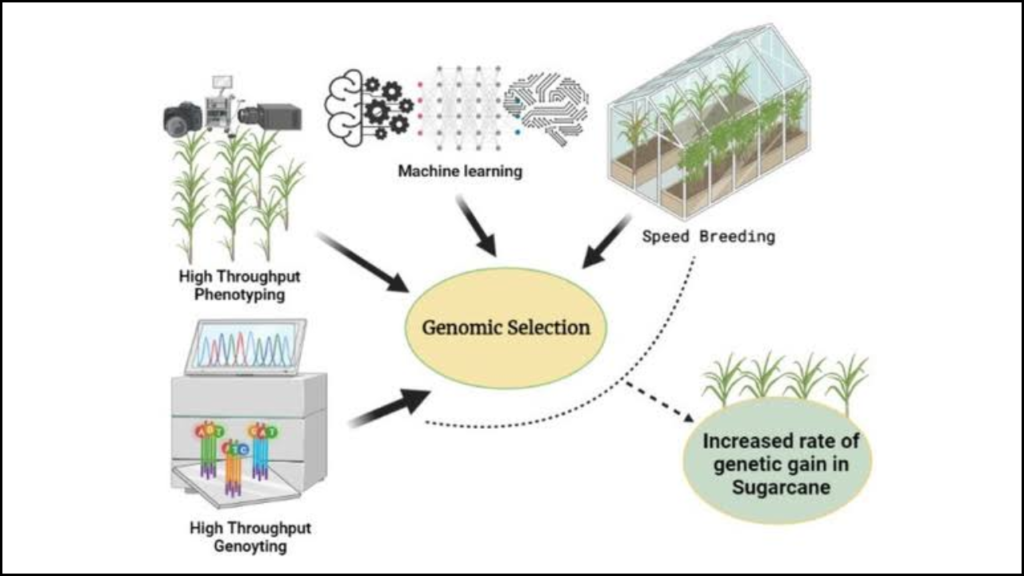
Modern agriculture faces the dual challenge of increasing crop productivity while ensuring sustainability under changing climates and limited resources. Traditional breeding methods, while effective, are time-consuming and often limited by the complexity of polygenic traits such as yield, drought tolerance, and disease resistance. Genomic selection (GS) has emerged as a transformative tool that leverages genome-wide marker data to predict the breeding value of plants, accelerating selection and enhancing the efficiency of crop improvement programs.
This article explores how genomic selection is integrated into field crop breeding, its advantages, methodologies, and implications for sustainable agriculture.
Table of Contents
Genomic Selection in Field Crops
| Aspect | Significance |
|---|---|
| Target Crops | Wheat, maize, rice, barley, soybean, sorghum |
| Traits Improved | Yield, disease resistance, stress tolerance, quality traits |
| Methodology | Genome-wide marker profiling, statistical prediction models |
| Benefits | Accelerated breeding cycles, increased selection accuracy |
| Challenges | High initial genotyping costs, need for large reference populations |
Principle of Genomic Selection
Genomic selection predicts the genetic potential of breeding lines using dense molecular markers covering the entire genome. Unlike marker-assisted selection, which targets a few major genes or quantitative trait loci (QTLs), GS incorporates genome-wide marker effects to capture the influence of both major and minor genes.
A reference population is phenotyped for target traits and genotyped for molecular markers. Statistical models, such as genomic best linear unbiased prediction (GBLUP) or Bayesian methods, are trained on this data to estimate marker effects. These models then predict genomic estimated breeding values (GEBVs) of untested individuals, enabling selection before field evaluation.
Applications in Field Crop Breeding
Genomic selection has been successfully applied in major field crops:
- Wheat: Enhances yield stability, grain quality, and disease resistance under varying environments.
- Maize: Accelerates hybrid development and improves drought tolerance.
- Rice: Optimizes multiple traits such as grain number, stress adaptation, and nutrient use efficiency.
- Barley and Sorghum: Improves biomass, protein content, and resilience to abiotic stress.
- Soybean: Enhances seed protein content, oil composition, and resistance to pests and diseases.
By predicting breeding values early, GS reduces the need for extensive multi-location field trials and shortens breeding cycles.
Integration into Breeding Programs
Integrating genomic selection requires careful planning and data management:
- Reference Population Development: A diverse and well-characterized population is essential for accurate prediction.
- High-Density Genotyping: Molecular markers such as SNP arrays or genotyping-by-sequencing provide genome-wide coverage.
- Statistical Modeling: Models predict GEBVs for selection candidates based on marker effects.
- Selection and Advancement: Individuals with superior GEBVs are advanced for crossing, hybridization, or field evaluation.
- Validation: Selected lines are tested to confirm predicted performance and refine models for future cycles.
Integration is often combined with conventional selection to maintain agronomic performance and adaptability while accelerating genetic gain.
Advantages of Genomic Selection
- Accelerated Breeding: Reduces the time from cross to variety release by predicting performance at early stages.
- Higher Selection Accuracy: Captures effects of both major and minor genes, especially for complex traits.
- Resource Efficiency: Minimizes the need for large-scale multi-environment phenotyping.
- Simultaneous Improvement of Multiple Traits: Enables selection for yield, stress tolerance, and quality traits concurrently.
- Better Utilization of Genetic Diversity: Leverages genome-wide variation to optimize breeding decisions.
These advantages make GS particularly useful in crops with long generation times or complex traits controlled by many loci.
Challenges and Considerations
Despite its benefits, genomic selection faces several challenges:
- Initial Investment: High costs of genotyping and computational infrastructure may limit adoption in resource-poor breeding programs.
- Model Accuracy: Prediction accuracy depends on population size, relatedness, and marker density.
- Environmental Interactions: Genotype × environment interactions may reduce predictive power if not accounted for in models.
- Data Management: Large genomic and phenotypic datasets require robust storage, analysis, and interpretation tools.
Careful design, adequate reference populations, and model optimization are essential to maximize the benefits of GS.
Future Opportunities
Advances in high-throughput genotyping, phenomics, and bioinformatics are expanding the scope of genomic selection. Machine learning and AI models are being used to improve prediction accuracy and incorporate environmental data. CRISPR and other gene-editing tools may be combined with GS to rapidly introgress superior alleles into elite germplasm.
Integration of genomic selection with precision agriculture can further enhance crop performance by linking genetic potential with optimal management practices. These innovations promise a new era of faster, more efficient, and data-driven crop breeding.
Last Words
Genomic selection has fundamentally transformed field crop breeding by enabling early, precise, and efficient prediction of breeding values. Its integration into breeding programs accelerates the development of high-yielding, stress-tolerant, and quality-enhanced crop varieties. While initial costs and technical challenges exist, the long-term benefits in terms of accelerated genetic gain, resource efficiency, and sustainable agriculture make GS an indispensable tool for modern plant breeding.