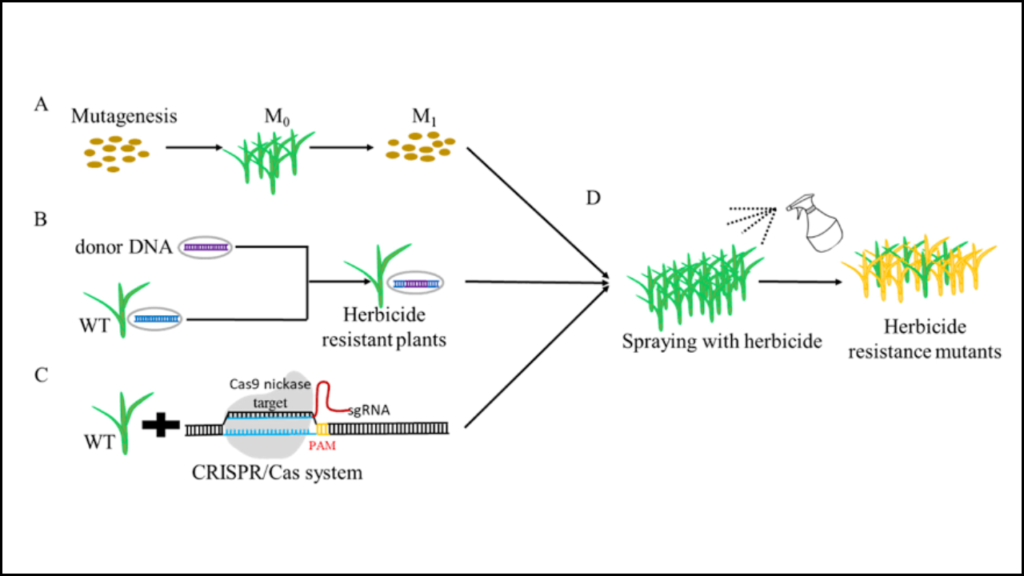
Herbicide tolerance is a critical trait in modern agriculture, allowing crops to withstand weed control chemicals while maintaining high productivity. Weeds compete with crops for nutrients, water, and light, causing significant yield losses if unmanaged. Traditional breeding and transgenic approaches have developed herbicide-tolerant varieties, but recent advances in gene-editing technologies, particularly CRISPR (Clustered Regularly Interspaced Short Palindromic Repeats), have revolutionized crop improvement by enabling precise, efficient, and targeted genetic modifications.
CRISPR technology facilitates the development of crops that can tolerate specific herbicides without introducing foreign DNA, accelerating the breeding process and enhancing agricultural sustainability. This article explores the applications, mechanisms, advantages, and challenges of using CRISPR in creating herbicide-tolerant crops.
Table of Contents
CRISPR in Herbicide-Tolerant Crops
| Aspect | Significance |
|---|---|
| Target Trait | Herbicide tolerance (glyphosate, glufosinate, ALS inhibitors) |
| CRISPR Mechanism | Genome editing via Cas nucleases and guide RNAs |
| Precision | Targeted mutation without foreign DNA insertion |
| Crop Applications | Rice, maize, soybean, wheat, tomato |
| Breeding Benefits | Reduced development time, stable trait expression |
Mechanism of CRISPR-Based Herbicide Tolerance
CRISPR technology utilizes a nuclease enzyme, typically Cas9, guided by a synthetic RNA molecule to a specific genomic sequence. The enzyme introduces precise cuts at the target site, which can be repaired naturally by the plant’s DNA repair mechanisms, creating mutations that alter gene function.
In herbicide tolerance, CRISPR targets genes that encode herbicide-sensitive enzymes, such as:
- EPSPS (5-enolpyruvylshikimate-3-phosphate synthase): Confers glyphosate tolerance by modifying the enzyme to resist herbicide binding.
- ALS (acetolactate synthase): Confers tolerance to ALS-inhibiting herbicides by altering the enzyme’s active site.
- GS (glutamine synthetase): Confers glufosinate tolerance through mutations that prevent herbicide inhibition.
These precise modifications enable crops to survive herbicide application while maintaining normal growth and yield.
Applications in Major Crops
CRISPR-mediated herbicide tolerance has been successfully applied to various crops:
- Rice: Edited EPSPS and ALS genes confer resistance to glyphosate and imidazolinone herbicides.
- Maize: Mutations in ALS genes result in tolerance to sulfonylurea herbicides.
- Soybean: CRISPR targeting of EPSPS allows glyphosate-tolerant varieties without transgene insertion.
- Wheat and Tomato: Targeted gene edits provide resistance to ALS inhibitors and glufosinate, enhancing weed management.
By using CRISPR, these crops achieve herbicide tolerance more rapidly than conventional breeding or transgenic approaches while avoiding regulatory and public concerns associated with genetically modified organisms (GMOs).
Advantages of CRISPR Over Traditional Methods
- Precision: CRISPR allows targeted gene edits without affecting unrelated regions of the genome.
- Efficiency: Rapid development of herbicide-tolerant varieties compared to traditional breeding cycles.
- Transgene-Free Products: Mutations can be generated without inserting foreign DNA, reducing regulatory hurdles.
- Stacking Traits: Multiple genes can be edited simultaneously, enabling tolerance to different herbicide classes.
- Cost-Effectiveness: Reduces the time, labor, and resources needed for developing resistant cultivars.
These advantages make CRISPR an attractive tool for modern agriculture, especially in regions seeking sustainable weed management solutions.
Challenges and Considerations
Despite its potential, CRISPR-based herbicide tolerance faces several challenges:
- Off-Target Mutations: Unintended edits may occur, requiring careful screening.
- Regulatory Frameworks: Legal classification varies across countries; some consider CRISPR-edited crops non-GMO, while others treat them as genetically modified.
- Trait Stability: Edited traits must be stably inherited across generations and under diverse environmental conditions.
- Public Acceptance: Consumer perception and awareness of genome-edited crops influence adoption.
Addressing these challenges involves rigorous molecular screening, field testing, and transparent communication about safety and benefits.
Integration with Breeding Programs
CRISPR-edited herbicide-tolerant traits are integrated into elite breeding lines through conventional crossing. This ensures that edited traits are combined with high yield, disease resistance, and environmental adaptability. Marker-assisted selection further accelerates the introgression of CRISPR-derived edits into diverse germplasm.
Combined with integrated weed management practices, CRISPR-based herbicide-tolerant crops can reduce overall chemical usage, improve crop productivity, and support sustainable agriculture.
Future Prospects
The future of CRISPR in herbicide tolerance includes:
- Multiplex Editing: Simultaneous editing of multiple herbicide target genes to develop broad-spectrum tolerance.
- Enhanced Precision Tools: Next-generation Cas enzymes with higher specificity and reduced off-target effects.
- Global Adoption: Wider use in minor crops, enabling sustainable weed control across diverse farming systems.
- Integration with Omics Technologies: Combining CRISPR with genomic, transcriptomic, and metabolomic data to optimize herbicide tolerance without compromising yield or quality.
These advancements promise faster, more precise, and sustainable development of herbicide-tolerant crops.