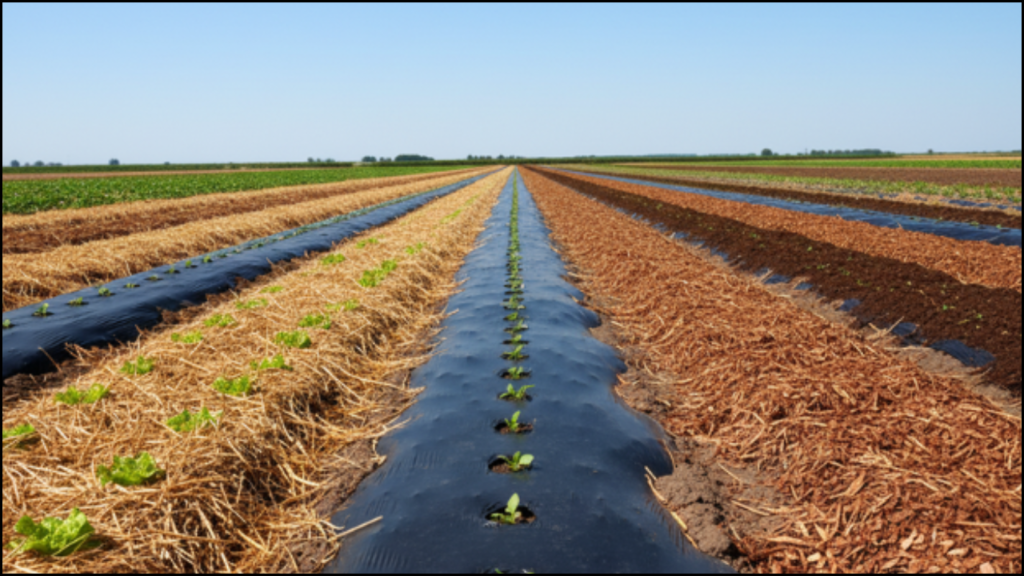
Mulching is an essential agronomic practice widely used to improve crop performance, conserve natural resources, and enhance soil health. In agricultural systems, weed competition and rapid soil moisture loss are two major constraints that reduce yield potential and increase production costs. Mulching directly addresses these challenges by covering the soil surface with organic or inorganic materials that modify the soil environment in favor of crop growth.
By acting as a protective barrier, mulching supports sustainable farming practices across different climatic regions. Its benefits extend beyond weed control and moisture conservation to include temperature regulation, soil protection, and long-term fertility improvement. This article examines the role of mulching in weed suppression and soil moisture conservation while highlighting its broader agronomic value.
Table of Contents
Role of Mulching in Crop Production
| Aspect | Contribution |
|---|---|
| Weed Control | Reduces weed emergence |
| Moisture Conservation | Limits evaporation losses |
| Soil Protection | Prevents erosion and crusting |
| Temperature Stability | Moderates soil temperature |
| Soil Health | Improves organic matter |
Weed Control
Mulching plays a critical role in weed control by physically blocking sunlight from reaching the soil surface. Most weed seeds require light to germinate, and a well-applied mulch layer prevents this process. As a result, weed emergence is significantly reduced, allowing crops to grow with less competition for nutrients, water, and space.
Consistent weed suppression through mulching also limits weed seed production over time. Reduced weed pressure lowers the need for mechanical weeding and chemical herbicides. This not only decreases production costs but also supports environmentally responsible farming by minimizing chemical inputs.
Moisture Conservation
Soil moisture conservation is one of the most important benefits of mulching, especially in water-limited environments. Mulch reduces direct evaporation from the soil surface by acting as a protective layer. This helps retain moisture in the root zone for longer periods, ensuring continuous water availability for crops.
Improved moisture retention supports better nutrient uptake and plant growth. When soil moisture remains stable, crops experience reduced stress during dry spells. This stability contributes to improved crop vigor, better yield formation, and enhanced resilience under variable climatic conditions.
Soil Protection
Mulching protects soil from erosion caused by wind and rainfall. Bare soil surfaces are vulnerable to erosion, leading to the loss of fertile topsoil and essential nutrients. Mulch absorbs the impact of raindrops and reduces surface runoff, preserving soil structure and fertility.
In addition to erosion control, mulching reduces surface crust formation. Crusting restricts water infiltration and root penetration, negatively affecting crop establishment. By maintaining a loose soil surface, mulching promotes healthy root growth and improved water movement.
Temperature Regulation
- Reduces extreme soil temperature fluctuations
- Maintains favorable root zone conditions
- Supports microbial activity
- Improves crop establishment
Mulching acts as an insulating layer that moderates soil temperature throughout the growing season. During hot conditions, mulch prevents excessive soil heating, while in cooler periods it helps retain warmth. This temperature moderation creates a stable environment for root development.
Stable soil temperatures enhance microbial activity responsible for nutrient cycling. Improved biological processes support nutrient availability and overall soil health, contributing to stronger crop growth and improved productivity.
Organic Matter Addition
Organic mulches such as crop residues, straw, and compost gradually decompose and add organic matter to the soil. This organic input improves soil structure, increases water-holding capacity, and enhances nutrient retention. Over time, soils with higher organic matter become more resilient and productive.
Organic matter also supports beneficial soil organisms, including earthworms and microorganisms. These organisms improve soil aeration and nutrient cycling, creating a healthier soil ecosystem that supports sustainable crop production.
Water Infiltration
- Improved infiltration rates
- Reduced surface runoff
- Enhanced root zone moisture
- Better rainfall utilization
Mulching improves water infiltration by maintaining soil structure and preventing surface sealing. Rainfall and irrigation water penetrate the soil more effectively, reducing losses through runoff. Improved infiltration ensures that water reaches deeper soil layers where crop roots can access it.
Enhanced infiltration efficiency is particularly valuable during heavy rainfall events. Mulched soils absorb water more effectively, reducing erosion and waterlogging while supporting a consistent crop water supply.
Soil Health Improvement
Mulching contributes significantly to long-term soil health by improving physical, chemical, and biological properties. Physically, mulch enhances soil aggregation and reduces compaction. Chemically, it supports nutrient retention and gradual nutrient release. Biologically, it promotes microbial diversity and activity.
Healthy soils are more resilient to stress and support higher crop productivity. By improving soil health, mulching becomes a foundational practice for sustainable agriculture and long-term land productivity.
Crop Yield Impact
The combined effects of weed suppression, moisture conservation, and improved soil health lead to measurable yield improvements. Reduced weed competition allows crops to utilize nutrients and water more efficiently. Stable soil moisture supports uninterrupted growth and grain development.
Yield benefits from mulching are especially noticeable under dry or stress-prone conditions. Crops grown with mulching often show improved uniformity, better quality, and higher market value compared to those grown on bare soil.
Management Practices
Effective mulching requires careful selection of mulch material and appropriate application thickness. Insufficient mulch provides limited benefits, while excessive mulch may restrict water infiltration or delay soil warming. Proper management ensures optimal performance.
Mulching should be integrated with other agronomic practices such as proper fertilization and irrigation management. When used as part of an integrated crop management system, mulching maximizes both productivity and sustainability.
Key Takeaways
The role of mulching in weed control and soil moisture conservation is fundamental to sustainable crop production. By suppressing weeds, reducing evaporation, protecting soil, regulating temperature, and enhancing soil health, mulching improves both short-term crop performance and long-term soil productivity. Adopting mulching as a regular practice supports efficient resource use, reduced input dependency, and resilient agricultural systems capable of meeting future production challenges.